TL;DR
DBT is a skills-based talk therapy that teaches you to handle intense emotions without turning to drugs or alcohol.
It rests on one idea: you can accept yourself as you are and still work hard to change.
Standard DBT has four parts: individual therapy, a skills group, phone coaching, and a team for your therapist.
It fits people with substance use plus emotional swings, self-harm urges, or relationship chaos.
Wellness Recovery Center of New Jersey can help you work out whether DBT belongs in your plan.
Table of Contents
How DBT works in addiction and co-occurring disorder treatment
What to expect: individual therapy, skills groups, and phone coaching
Introduction
For many people, the hardest part of quitting is not the cravings. It is what sits underneath them: a rush of shame, a fight with a spouse, a wave of panic that feels like it will never end. Drinking or using was the one thing that made those moments stop.
So what is Dialectical Behavior Therapy? It is a form of talk therapy built to teach you what to do in those moments instead. If you have searched "what is DBT" because a counselor mentioned it, or because you are looking for DBT near me, this guide explains it in plain terms. It also covers who it helps and what the weeks of treatment look like.
What Is Dialectical Behavior Therapy (DBT)?
Dialectical Behavior Therapy is a structured therapy that teaches practical skills for managing emotions, getting through crises, and handling relationships. It is not mainly about digging through your past. It is about what you can do today, in the next ten minutes, when things feel unbearable.
When people ask what DBT is, the short answer is this: a skills class and a therapy relationship working together. You learn a skill, you practice it between sessions, and you bring back what worked and what did not.
Treatment for substance use sits inside a wider medical field. Federal research bodies such as the National Institute on Drug Abuse describe addiction as a condition with many treatment options, not a single fix.[1] DBT is one of those options, and it is often used alongside other care rather than alone.

The origins of DBT and the meaning of "dialectical"
Psychologist Marsha Linehan developed DBT in the late 1980s for people with chronic suicidal thoughts and borderline personality disorder. Standard cognitive therapy was not working well for them. It often felt like being told they were wrong to feel what they felt.
"Dialectical" means holding two things that seem to conflict. In DBT, the main pair is acceptance and change. You are doing the best you can, and you also need to do better. Both are true.
That balance matters in addiction care. Many people arrive carrying years of blame. A therapy that says "your pain makes sense, and here is another way to cope with it" is easier to stay in than one that only pushes.
Borderline personality disorder is one of the conditions defined in the DSM-5-TR, the standard classification of mental disorders used by clinicians in the United States.[2] DBT is now used well beyond that diagnosis.

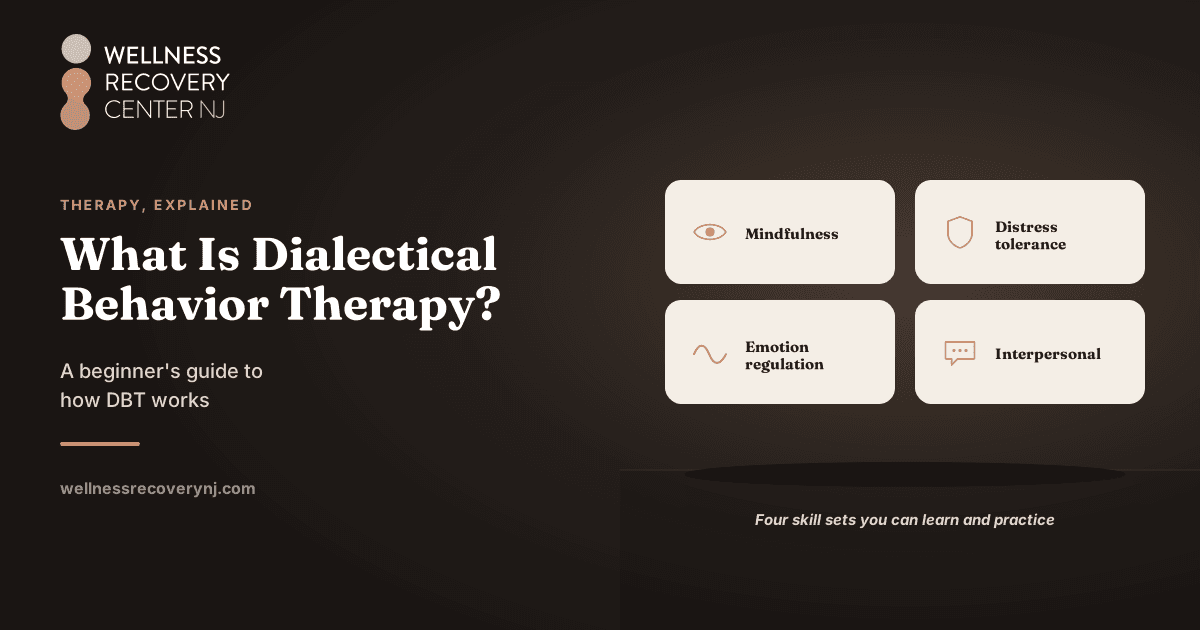
The four core DBT skill modules: mindfulness, distress tolerance, emotion regulation, and interpersonal effectiveness
DBT teaches four groups of skills. Each one targets a different place where people with substance use tend to get stuck.
Module | What it teaches | Example in recovery |
|---|---|---|
Mindfulness | Noticing thoughts and urges without acting on them | Watching a craving rise and fall instead of obeying it |
Distress tolerance | Getting through a crisis without making it worse | Using cold water or paced breathing to ride out an urge to drink |
Emotion regulation | Understanding and lowering intense feelings | Spotting the early signs of anger before it peaks |
Interpersonal effectiveness | Asking for what you need and saying no clearly | Turning down a drink from a friend without a fight |
Mindfulness comes first because the other three depend on it. You cannot change a reaction you do not notice.
Distress tolerance is often the module people need soonest. It gives you something to do for the worst twenty minutes, which is often when a relapse would otherwise happen.

How DBT works in addiction and co-occurring disorder treatment
Many people use substances to numb feelings they have no other way to manage. DBT goes after that gap directly. It does not just ask you to stop. It gives you replacement skills for each situation that used to end in a drink or a dose.
Alcohol use disorder and drug use disorder are medical conditions, and the National Institute on Alcohol Abuse and Alcoholism lists treatment for alcohol problems as a range of approaches, including behavioral therapies.[3] DBT is one behavioral approach within that range.
It is especially useful when substance use comes with other struggles:
Intense mood swings or anger that feels out of proportion
Self-harm or thoughts of suicide
Anxiety or depression that returns when you stop using
Relationships that swing between close and explosive
Treating both problems together is called dual diagnosis care, and our dual diagnosis program is built around it. The ASAM Criteria, a set of guidelines used to plan addiction care, uses a person-centered approach for patients with addiction and co-occurring conditions.[4]
If panic is part of your story, our piece on anxiety attacks after drinking or quitting explains why it happens. If you are weighing trauma care too, see our guide to EMDR. DBT and trauma therapy often work well together.

What to expect: individual therapy, skills groups, and phone coaching
Full DBT has several parts that run at the same time. Each does a different job.
Individual therapy: A weekly one-on-one session. You and your therapist look at what happened that week, including urges, slips, and hard moments, and decide which skill fits.
Skills group: A class-style group where you learn the four modules and get homework. It is more like a workshop than a circle of confession.
Phone coaching: Brief calls to your therapist when you are in a tough spot and need help using a skill right then. Availability varies by program, so ask about it.
Therapist consultation team: Your therapist meets with colleagues to stay on track. You do not attend, but it shapes your care.
A full course of standard DBT often runs about six months to a year. In addiction programs the skills are often taught in a shorter, condensed form inside a day program or outpatient track, and you can keep building on them afterward. Your own timeline depends on your needs and the level of care you start in.
At Wellness Recovery Center of New Jersey, skills work can fit into several levels of care, including partial hospitalization, an intensive outpatient program, and a standard outpatient program. If your main struggle is emotional, a mental health IOP may fit. If you are new to treatment, what to expect on your first day walks through intake.

Is DBT right for you? Finding DBT near me in New Jersey
DBT may be a good fit if strong emotions drive your use, if you have tried to quit and kept being pulled back by crisis, or if talking about feelings alone has not changed what you do. It asks for effort. You will have homework, and you will practice skills when you do not feel like it.
It may be less of a fit on its own if you are in medical danger from withdrawal or need stabilizing first. Detox and medication come first in that case, and therapy follows. Our articles on alcohol detox and medication for alcohol use cover those steps.
To find DBT near me options in New Jersey, you can ask a treatment center directly whether they teach DBT skills, how often, and in what format. You can also use the SAMHSA treatment locator, which lists programs by location, or call the SAMHSA helpline.[5] NIDA also lists the same locator and the number 1-800-662-HELP (4357).[1]
Questions about cost are fair. Our guide on whether New Jersey rehabs take insurance shows how to check your benefits before you call. If you are still deciding whether it is time, see 6 signs it is time to seek drug rehab, and for what to look for in a program, what makes a great rehab.
Frequently Asked Questions
Q: What is DBT and how is it different from CBT?
A: DBT is a therapy that grew out of cognitive behavioral therapy (CBT). CBT focuses on changing unhelpful thoughts. DBT adds acceptance, mindfulness, and specific skills for intense emotions, and it uses a group and coaching format. People who find CBT too much like being told to "think differently" often do better with DBT.
Q: How does DBT help with drug and alcohol addiction?
A: It gives you ways to get through cravings and emotional pain without using. You learn to notice an urge, ride it out, lower the feeling behind it, and ask for help from people around you. It works best alongside other treatment, such as medication when needed and a relapse prevention plan.
Q: How long does DBT treatment usually take?
A: Full standard DBT often runs six months to a year, since the skills are taught in cycles. In addiction programs, a shorter version may be built into a day program or intensive outpatient schedule. Your care team can tell you what is realistic for you.
Q: Can DBT treat co-occurring mental health conditions like depression, anxiety, or borderline personality disorder?
A: DBT was first built for borderline personality disorder, and it is also used for depression, anxiety, and other conditions where emotions run high. A proper assessment decides what you have. Treating a mental health condition and a substance use disorder together is called dual diagnosis care.
Q: How do I find DBT near me in New Jersey, and does insurance cover it?
A: Search the SAMHSA treatment locator or call a program and ask if they teach DBT skills. Many insurance plans cover therapy as part of addiction or mental health treatment, but coverage varies by plan. Call the number on your insurance card, or ask the treatment center to verify your benefits for you.
Conclusion
So, what is Dialectical Behavior Therapy? It is a practical, skills-first therapy that helps you stay steady when emotions run high, so that drinking or using is no longer the only way through. Knowing what DBT is can make the first call easier, and finding DBT near me options in New Jersey is a matter of asking the right questions.
If you or someone you love is struggling, Wellness Recovery Center of New Jersey can talk through your situation and help you decide on a next step. You can start at wellnessrecoverynj.com. One call is enough to begin.
References
National Institute on Drug Abuse. (n.d.). NIDA.NIH.GOV | National Institute on Drug Abuse (NIDA). - https://nida.nih.gov
American Psychiatric Association. (n.d.). Psychiatry.org - DSM. - https://www.psychiatry.org/psychiatrists/practice/dsm
National Institute on Alcohol Abuse and Alcoholism. (n.d.). National Institute on Alcohol Abuse and Alcoholism (NIAAA). - https://www.niaaa.nih.gov
American Society of Addiction Medicine. (n.d.). ASAM - American Society of Addiction Medicine. - https://www.asam.org
Substance Abuse and Mental Health Services Administration. (n.d.). Home | SAMHSA. - https://www.samhsa.gov
Ready to talk to someone?
Confidential, judgment-free, available 24/7.