TL;DR
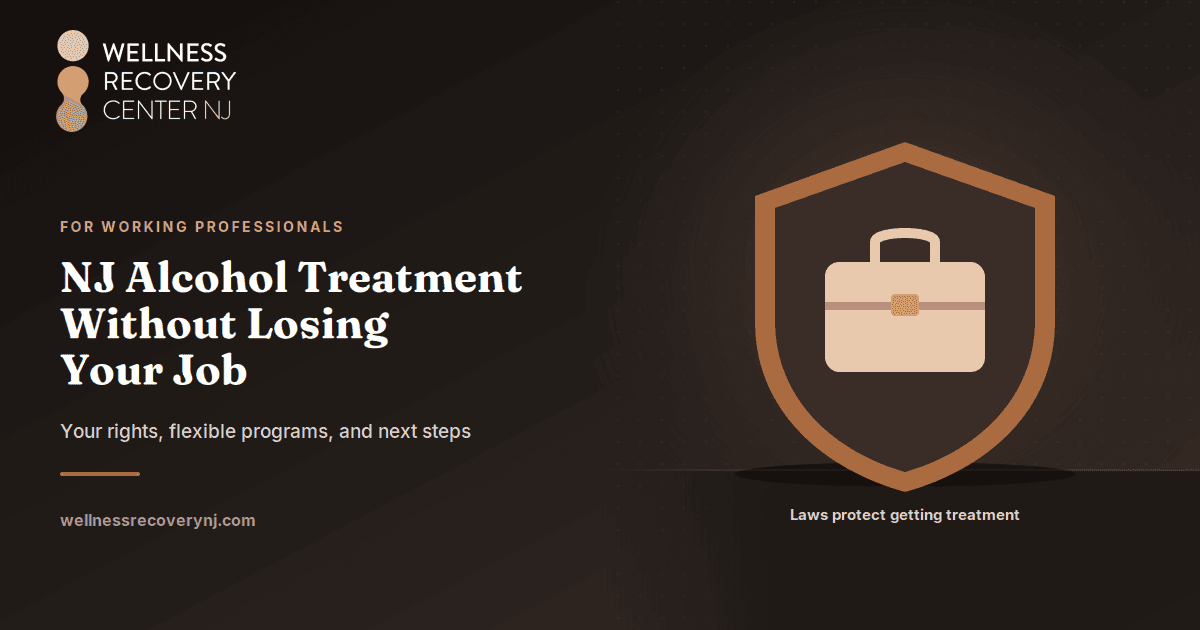
Many working people can get NJ alcohol treatment without losing their jobs. Federal and state laws give real protections, though they have limits.
You do not have to choose between your job and your health. Partial hospitalization, intensive outpatient, and outpatient programs are built around work schedules.
You usually do not have to tell your employer the reason for your leave. You may need to share medical certification with HR if you use FMLA.
The right level of care depends on your medical needs, not on how much work you can afford to miss. A clinical assessment decides it.
If you are unsure where to start, a confidential call to a treatment center or the SAMHSA National Helpline is a safe first step.
Table of Contents
Why so many professionals delay getting help for alcohol use
Know your rights: FMLA, ADA, and job protections when seeking treatment
Detox, inpatient, outpatient, or IOP: choosing the right level of care
How to talk to your employer or HR about treatment (and when not to)
Taking the first step toward recovery without putting your career at risk
Introduction
You are good at your job. You answer email at 11 p.m., you show up to the meetings, and nobody at work knows how many drinks it takes to get you through the evening. Now you are wondering if you need help, and your first thought is not about your health. It is about what happens if someone finds out.
That fear is common, and it keeps a lot of capable people from calling anyone. This article covers NJ alcohol treatment for people who work: what the law protects, which programs fit around a full-time job, and how to handle the conversation with your employer. We are Wellness Recovery Center of New Jersey, and we hear this worry from nearly every professional who walks in. The short answer is yes, you can get help and keep your career. The longer answer is below.
Why so many professionals delay getting help for alcohol use
High-functioning does not mean low-risk. Alcohol use disorder (AUD) is a medical condition defined by an impaired ability to stop or control drinking despite social, occupational, or health consequences, and it can be mild, moderate, or severe.[1] Plenty of people with AUD still hit their deadlines. That is part of why it goes unnoticed for years.
The reasons people wait tend to be practical, not stubborn:
You worry a diagnosis or a rehab stay will follow you into reviews, promotions, or licensing.
You cannot picture being gone for 30 days when clients depend on you.
You believe you should be able to handle it with willpower.
You assume treatment means a facility far from home and a long gap on your calendar.
Willpower is a weak tool here. The NIAAA notes that lasting changes in the brain caused by alcohol misuse perpetuate AUD and make people vulnerable to relapse.[1] It is a brain disorder, not a character flaw. The same source says evidence-based treatment with behavioral therapies, mutual-support groups, and medications can help people with AUD achieve and maintain recovery, however severe the problem seems.[1]

Know your rights: FMLA, ADA, and job protections when seeking treatment
We are a treatment provider, not a law firm, so treat this as a starting map. Details depend on your employer's size, your job, and how long you have worked there. An employment attorney or your HR department can confirm what applies to you.
Protection | What it generally does | Common limits |
|---|---|---|
FMLA (Family and Medical Leave Act) | Up to 12 weeks of unpaid, job-protected leave per year for a serious health condition, which can include treatment for a substance use disorder | Employer must have 50 or more employees; you must meet hours and tenure rules |
ADA (Americans with Disabilities Act) | Can protect people in treatment or recovery from discrimination and may require reasonable accommodations such as a schedule change | Does not protect current impairment on the job; employers can enforce conduct and performance rules |
New Jersey Family Leave Act and state leave laws | State-level leave and paid-leave programs may offer additional options | Rules differ from federal law; confirm eligibility with the state or HR |
Remember this pattern: the law generally protects you for getting treatment, not for drinking at work. If you get help before a policy violation happens, you are usually in a stronger position than if you wait until there is a problem on record.
The SAMHSA National Helpline also lists a Drug-Free Workplace Helpline among its resources, which can point employers and employees toward answers on workplace policy.[2]

NJ alcohol treatment options that fit a work schedule
Treatment does not have to mean disappearing for a month. Many NJ alcohol treatment programs run in the daytime, in the evening, or in a mix, and the time you spend in care steps down as you stabilize.
At Wellness Recovery Center of New Jersey, the options that people with jobs ask about most are:
Partial hospitalization: several hours a day, most days of the week, while you sleep at home. It often works with a short leave from work.
Intensive outpatient: fewer hours per week than partial hospitalization, often scheduled so you can keep working part or all of your week.
Outpatient program: the lightest weekly commitment, suited to people who are stable and need ongoing support.
Ask any program about its current session times before you commit. Schedules change, and a good intake team will tell you plainly whether your work hours can fit.

Detox, inpatient, outpatient, or IOP: choosing the right level of care
Your job should not pick your level of care. Your medical situation should. The ASAM Criteria is a standard framework many clinicians use: it assesses a person's medical, psychological, and social needs, then matches them to a level of care and an individualized treatment plan.[3] It also aims to reduce both under-treatment and over-treatment.[3]
Level of care | Who it often fits | Time away from work |
|---|---|---|
Medical detox | Heavy daily drinkers at risk of dangerous withdrawal | Typically several days to a week; plan on leave |
Inpatient or residential | Unsafe home environment, repeated relapse, or serious medical or mental health needs | Usually weeks; leave required |
Partial hospitalization | Need daily structure but can safely sleep at home | Most of the workday, often for a few weeks |
Intensive outpatient | Stable enough to work while attending several sessions a week | Part of the week |
Outpatient | Early recovery with strong supports, or stepping down from higher care | Minimal |
One safety point. If you drink heavily every day, do not stop suddenly on your own to avoid missing work. Withdrawal can be dangerous. Our guide to what happens during alcohol detox explains why medical supervision matters.
If anxiety, depression, or past trauma is mixed in with the drinking, ask about dual diagnosis care or a mental health IOP. The NIAAA lists depression, PTSD, and ADHD among conditions associated with higher AUD risk.[1]

How to talk to your employer or HR about treatment (and when not to)
You often have more control over this than you think. In many cases you can request medical leave or a schedule change without naming alcohol. Saying "a medical condition that needs treatment" is generally enough to start the process, though HR may ask for certification from your provider if you use FMLA.
Consider these steps:
Read your employee handbook for leave, EAP, and drug and alcohol policies first.
Ask your provider what paperwork they can complete and what it will say.
Take the request to HR or a benefits contact, not to a coworker or your direct manager, unless that is your normal route.
Put the request in writing and keep a copy.
There are times to say less, or to get advice first. If your job involves a license, safety-sensitive duties, or a union contract, talk to an attorney or union rep first, because specific rules can apply. You also do not owe colleagues an explanation. A short line such as "I'm taking medical leave and will be back on this date" is complete.

Paying for care: insurance, EAPs, and confidentiality
Cost worries stop people almost as often as job worries do. Start with your insurance card and call the member services number. Ask what is covered for partial hospitalization, intensive outpatient, and outpatient care, and whether pre-authorization is needed. Our admissions team can help check benefits at no charge.
An employee assistance program (EAP) is a benefit through your employer that usually offers a few free, confidential counseling sessions and referrals. It can be a gentle first step. Ask HR how your plan's EAP handles privacy before you call.
On confidentiality: federal privacy rules protect health information held by treatment providers, and substance use treatment records carry extra protections. Insurers generally send an explanation of benefits to the policyholder, which can matter if you are on a spouse's plan. Ask your insurer how to limit what is mailed.
If you are not sure where to turn, the SAMHSA National Helpline offers treatment referral and information, and FindTreatment.gov lists treatment options.[2]
For help picking a program, see our post on what makes a great addiction rehab in New Jersey.

Taking the first step toward recovery without putting your career at risk
The first step is smaller than you think. It is a phone call or an assessment, not a leave of absence. You can ask questions, learn what level of care is recommended, and decide what to tell work afterward.
If you are not sure drinking is the problem yet, our post on six signs it is time to seek rehab may help you sort that out. If medication is on your mind, read about medication in alcohol treatment. Early treatment is usually easier to fit into a work life than treatment after a crisis.
Frequently Asked Questions
Q: Can I get fired for going to alcohol treatment in New Jersey?
A: Employers generally cannot fire you simply for seeking treatment if you are covered by FMLA, the ADA, or New Jersey law. They can still enforce rules about drinking at work and job performance. Coverage depends on employer size and your tenure, so check with HR or an employment attorney.
Q: Do I have to tell my employer that I'm entering alcohol rehab?
A: Not always. You can often request medical leave without naming the condition. If you use FMLA, your employer may ask for certification from your provider that a serious health condition exists, but it does not have to say "alcohol."
Q: Can I use FMLA leave for inpatient or outpatient alcohol treatment?
A: Often yes, if you qualify. FMLA offers up to 12 weeks of unpaid, job-protected leave a year for a serious health condition, and treatment for alcohol use disorder can count. Leave can sometimes be taken in blocks or part-time for outpatient sessions.
Q: Are there NJ alcohol treatment programs with evening or flexible hours for people who work full-time?
A: Yes. Intensive outpatient and outpatient programs are designed for people who are working, and session times vary by program. Call and ask about current schedules, since they change.
Q: Will my health insurance or employee assistance program (EAP) cover alcohol treatment, and will my employer see the claims?
A: Many plans cover alcohol treatment, but coverage varies by plan and level of care. Claims go to your insurer, not directly to your employer, though a benefits report may show broad usage. EAP sessions are usually confidential, but ask how your plan handles records.
Conclusion
Getting NJ alcohol treatment does not have to cost you your job. Laws like FMLA and the ADA offer real protection, flexible programs fit around a work week, and you control a lot of what your employer learns. The biggest risk is waiting until drinking creates a crisis at work or at home.
If you or someone you love is worried about drinking, call Wellness Recovery Center of New Jersey at wellnessrecoverynj.com. We will talk through your schedule, your insurance, and the least disruptive level of NJ alcohol treatment that is still safe. The call is confidential, and you do not have to decide anything on it.
References
National Institute on Alcohol Abuse and Alcoholism (NIAAA). Understanding Alcohol Use Disorder. - https://www.niaaa.nih.gov/alcohols-effects-health/alcohol-use-disorder
Substance Abuse and Mental Health Services Administration (SAMHSA). National Helpline for Mental Health, Drug, Alcohol Issues. - https://www.samhsa.gov/find-help/national-helpline
American Society of Addiction Medicine (ASAM). ASAM Criteria. - https://www.asam.org/asam-criteria
Ready to talk to someone?
Confidential, judgment-free, available 24/7.