TL;DR
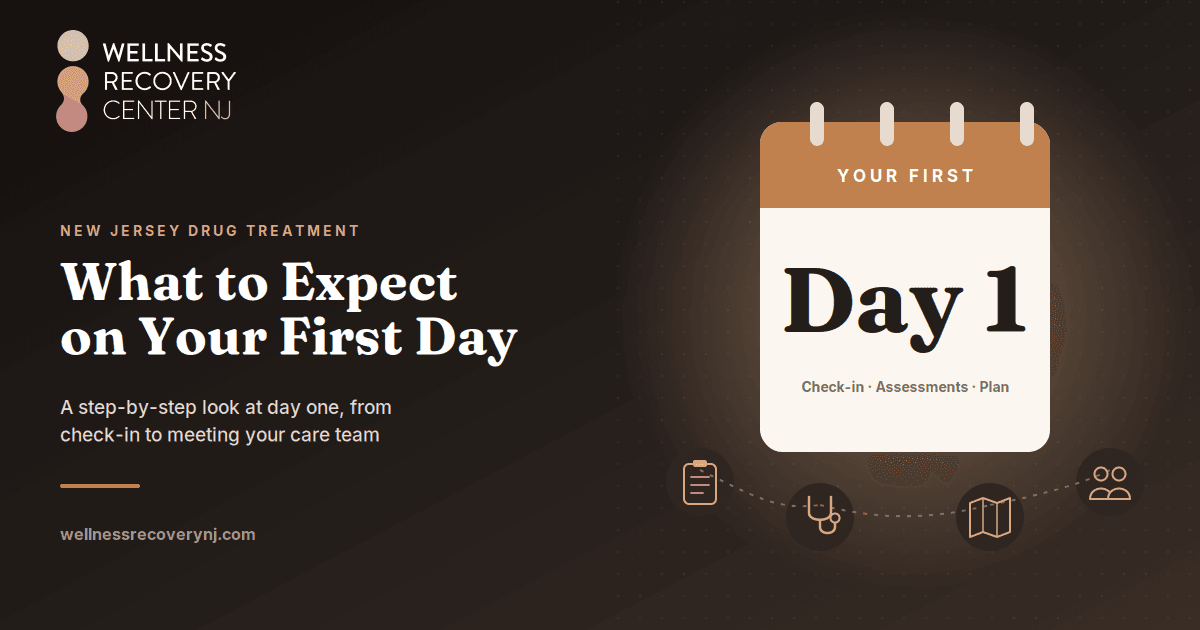
Day one of New Jersey drug treatment is mostly paperwork, conversation, and health checks. Nobody expects you to perform or explain everything.
Your assessments decide your level of care and your treatment plan, using a standard framework from the American Society of Addiction Medicine.
Whether you need detox, and whether medication is offered, depends on your medical evaluation, not on a one-size-fits-all rule.
Your privacy is protected, and family involvement is something you choose.
If you are not sure where to start, SAMHSA's National Helpline is free and open around the clock.
Table of Contents
Your initial assessments: medical, mental health, and substance use evaluations
Determining your level of care and building a treatment plan
Rules, privacy, and family involvement: setting expectations

Introduction
Most people who dread the first day of treatment are not afraid of the work. They are afraid of the unknown: who will be in the room, what they will be asked, whether they will be judged, whether anyone will take their phone. This article walks through the day in order, so the unknown gets smaller.
We are Wellness Recovery Center of New Jersey, and what follows is how New Jersey drug treatment typically begins at a program like ours. Details differ from one program to the next, so treat this as a map and not a promise. If you are still deciding whether it is time, our post on six signs it is time to seek drug rehab in New Jersey covers that question.
Before you arrive: how to prepare for your first day
Most of the preparation happens on the phone. An admissions staff member will ask about the substances you use, how often, your health history, and any medications you take. Answer as honestly as you can. Nothing you say on that call is used to turn you away, and accurate answers keep you safe on day one.
If you do not know where to begin, SAMHSA's National Helpline offers free, confidential help finding treatment, and its FindTreatment.gov locator lists programs by location.[1]
Photo ID and your insurance card, if you have one
A list of current medications, with doses, plus the pharmacy name
Names of your doctors and any prior treatment programs
Comfortable clothes for several days, and basic toiletries
Leave at home: valuables, large amounts of cash, alcohol-based products, and anything you would be upset to lose
Eat something and sleep if you can. Arrive as you are. You do not need to be sober for days beforehand, and in some cases stopping suddenly on your own is unsafe, which is why the medical team wants to see you first.

Arrival and check-in: what the intake process looks like
Intake is the front desk part of New Jersey drug treatment. A staff member greets you, confirms your identity, and walks you through consent forms. These cover treatment, privacy, and your rights as a patient. You can ask for any form to be read aloud or explained.
Expect a short wait and a lot of questions. It can feel like being interviewed, but it is closer to being measured for something that has to fit.
Staff may also do a brief safety check, which can include a look through your bag. This is routine and applies to everyone. It keeps the space safe for people in early recovery.

Your initial assessments: medical, mental health, and substance use evaluations
This is the longest part of the day. Three kinds of evaluation usually happen, sometimes with the same clinician and sometimes with different ones.
Medical: vital signs, a health history, and often lab work or a urine drug screen. A nurse or physician checks for withdrawal risk and for conditions that affect treatment.
Mental health: questions about mood, anxiety, trauma, sleep, and thoughts of self-harm. Many people in treatment have a co-occurring condition, and finding it early changes the plan.
Substance use: what you use, how much, how long, what has been tried before, and what happened.
The ASAM Criteria describes this as assessing a person's medical, psychological, and social needs, then developing an individualized treatment plan.[2] That means your answers have a purpose. They are not a test, and there are no wrong ones.
If depression or anger has been part of your story, our article on how depression and substance use connect in men may help you describe it.

Determining your level of care and building a treatment plan
Once the assessments are done, the team matches you to a level of care. ASAM's framework exists to match patients to the right level of care and to define what services each level should offer.[2] The goal is to avoid both too little treatment and too much.
Level | Typical fit |
|---|---|
Needs daily, structured clinical care but can sleep at home or in supportive housing | |
Stable enough to live at home while attending several sessions a week | |
Lower-intensity support, often a step down after a higher level | |
Substance use together with a mental health condition |
Your first treatment plan is a draft. It lists goals, the services you will attend, and who is responsible for what. The team reviews and changes it as you progress, and you have a say in it.

Detox and medication support: what to know on day one
Not everyone starts detox on day one. The medical evaluation decides whether you need it, how closely you need to be watched, and whether a higher level of care is safer first. Alcohol and some other substances can cause dangerous withdrawal, so the team never guesses at this step. Our guide to what happens during alcohol detox goes through that process in detail.
Medication is part of many treatment plans. SAMHSA describes medications as an effective option for treating substance use disorder, used along with counseling and other supports.[3] A prescriber will talk through options, side effects, and your preferences before anything is started. For alcohol specifically, see how medication helps people quit drinking.
Alcohol itself is worth naming. The NIAAA reports that it contributes to more than 200 chronic and acute health conditions,[4] which is one reason the medical check matters even if drugs are your main concern.
Meeting your care team and learning the daily schedule
By late in the day you will usually meet the people you will see most: a primary therapist, a case manager, a nurse, and a prescriber. Learn their names. Ask who to go to when something goes wrong at night or on a weekend.
You will also get a schedule. A typical day in a structured program mixes group therapy, individual sessions, skills work, meals, and free time. Some programs offer trauma-focused methods, such as EMDR therapy, once you are settled. If a mental health condition is driving your use, a mental health IOP may be part of the plan.
[Insert image of a sample daily schedule posted in a group room here]
Rules, privacy, and family involvement: setting expectations
Every program has house rules. Expect guidelines on substance-free conduct, attendance, visitors, phones, and respect for other patients. Ask for them in writing and ask why any rule exists. A good program can explain.
Your treatment records are protected by federal confidentiality law, and staff generally cannot confirm you are a patient without your written permission. You decide who is on the release list, and you can say who is not.
Family involvement works best when it is planned. Many programs offer family sessions and education. If you want them to know less, or nothing, say so at intake.
Frequently Asked Questions
Q: What should I bring with me to a New Jersey drug treatment program, and what should I leave at home?
A: Bring photo ID, your insurance card, a list of medications, and a few days of comfortable clothes and toiletries. Leave valuables, large amounts of cash, and alcohol-based products at home. Your program will give you its own list, so check it before you pack.
Q: How long does the intake and assessment process take on the first day?
A: Plan for several hours, often half a day. Paperwork, the medical exam, and the mental health and substance use interviews each take time. Programs vary, so ask when you call.
Q: Will I start detox right away, and will I receive medication to manage withdrawal?
A: It depends on your medical evaluation. If withdrawal is a risk, the team will say how it will be managed. Medication is one option within treatment for substance use disorder,[3] and a prescriber will review it with you first.
Q: Is my information kept confidential, and can my family or employer find out I'm in treatment?
A: Your records are protected, and staff generally need your written permission to share anything. You choose who goes on your release list. Ask your program how it handles employer paperwork, such as medical leave letters.
Q: Does insurance cover New Jersey drug treatment, and what happens if I am worried about cost or have no insurance?
A: Many private plans and New Jersey's Medicaid program cover some level of care, and SAMHSA's site links to Medicaid and insurance information by state.[1] If you are uninsured or worried about cost, tell admissions. They can check your benefits and talk through options before you commit.
Conclusion
The first day of New Jersey drug treatment is made of ordinary steps: paperwork, a health check, honest conversations, a plan, and an introduction to the people who will help. You do not have to be ready. You only have to arrive.
If you or someone you love is thinking about New Jersey drug treatment, contact Wellness Recovery Center of New Jersey at wellnessrecoverynj.com. Ask whatever scares you most. We would rather answer it today than have it keep you home tomorrow.
References
SAMHSA. National Helpline for Mental Health, Drug, Alcohol Issues. https://www.samhsa.gov/find-help/national-helpline
American Society of Addiction Medicine. ASAM Criteria. https://www.asam.org/asam-criteria
SAMHSA. Treatment Options for Substance Use Disorder. https://www.samhsa.gov/medications-substance-use-disorders
National Institute on Alcohol Abuse and Alcoholism. Core Resource on Alcohol. https://www.niaaa.nih.gov/health-professionals-communities/core-resource-on-alcohol
Ready to talk to someone?
Confidential, judgment-free, available 24/7.