TL;DR
Signs of depression in men often look like irritability, anger, risk-taking, and heavier drinking or drug use, not just sadness.
Depression and substance use can each cause or worsen the other, so the question of which came first is hard to answer alone.
A timeline of sober periods, family history, and symptoms that persist after substance use stops can help point to an answer.
A professional dual diagnosis assessment matters because treating only one condition often leaves the other in place.
If you are in crisis, call or text 988. For treatment options, call SAMHSA at 1-800-662-HELP (4357).
Table of Contents
Introduction
He stopped going to the gym. He snaps at the kids over small things. The drinks after work used to be two, and now nobody is counting. If this sounds like someone you love, or like you, you may be looking at the signs of depression in men without knowing it.
Many men never say "I'm depressed." They say they are tired, stressed, or fine. Alcohol or drugs can cover the problem for a few hours and then make it worse. This article explains how depression and substance use connect, what to look for, and how a clinician works out which came first. It also explains why that answer matters less than getting both treated.
Why signs of depression in men are often missed or misread
Many men learn early to handle pain by keeping quiet, staying busy, or acting tough. So low mood tends to come out sideways. It shows up as a short temper, a drink, long hours at work, or going silent at home.
Families often read these changes as a bad attitude or a drinking problem. Doctors can miss them too, since a man may mention poor sleep or back pain but not how he feels. The signs of depression in men get filed under something else, and the real cause goes untreated.
Substance use makes this harder to sort out. Alcohol and drugs change mood, sleep, and energy on their own, so it is hard to see what is depression and what is the substance. That is why clinicians use the DSM-5-TR, the manual U.S. clinicians use to classify mental disorders, with care when substances are involved.[1]

Common signs of depression in men: beyond sadness
Sadness can be part of it, but it is often not the loudest part. These are the signs of depression in men that families report most often:
Irritability, anger, or a short fuse that is new
Pulling away from friends, family, and things he used to enjoy
Sleeping too little or too much
Constant tiredness, aches, headaches, or stomach trouble with no clear cause
Trouble focusing or making decisions
Reckless behavior, such as driving fast or gambling
Drinking or using more than before
Feeling worthless, hopeless, or like a burden
Talk of death or suicide is never normal. If you hear it, call or text 988, the Suicide & Crisis Lifeline, listed on the SAMHSA site.[2]

What you may see | What may be going on underneath |
|---|---|
Yelling over small things | Irritability that comes with low mood |
Working nonstop | Avoiding feelings or staying too busy to think |
Drinking every night | Using alcohol to sleep or numb out |
"I'm just tired" | Fatigue and sleep change from depression |
Skipping plans | Withdrawal and loss of interest |

How substance use and depression feed each other
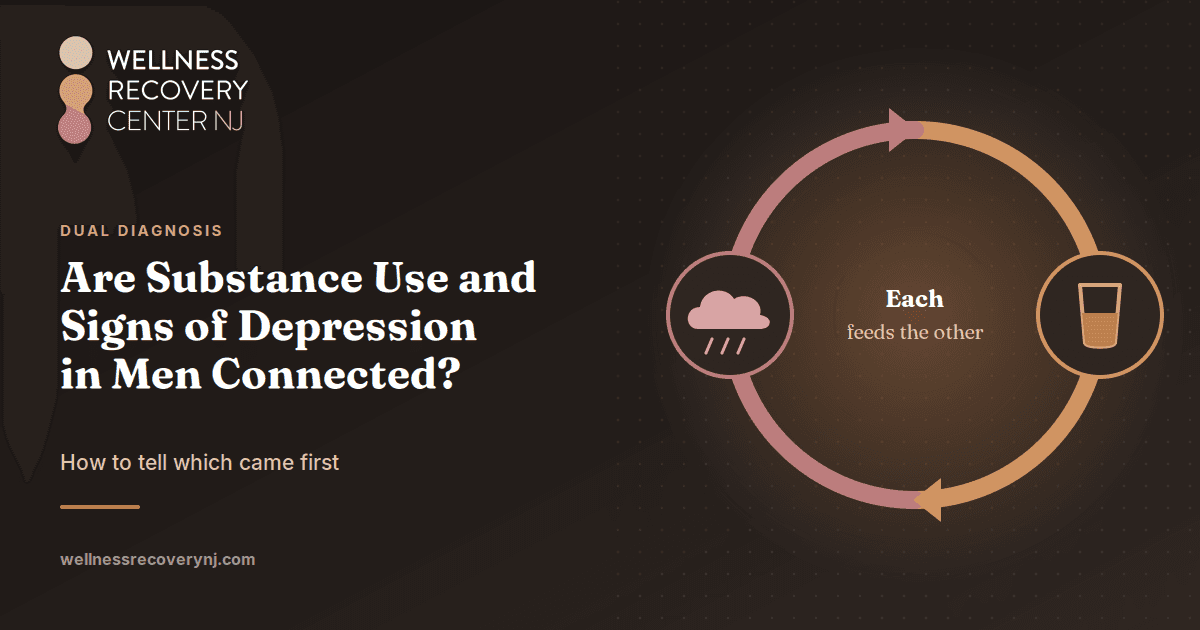
The link runs in both directions. A man with depression may drink to take the edge off, and a man who drinks heavily may become depressed as alcohol disrupts sleep, work, money, and relationships. Neither one has to cause the other for them to make each other worse.
The National Institute on Alcohol Abuse and Alcoholism (NIAAA) is the federal research body on how alcohol affects health, and it treats alcohol use disorder as a medical condition with its own treatment resources.[3] The National Institute on Drug Abuse (NIDA) does the same for drug use and addiction.[4]
In practice, the cycle often runs like this: mood drops, he uses to feel better, the substance wears off and mood drops lower, and shame about the using adds to the weight. After a few rounds, he can no longer tell where one problem stops and the other starts. Withdrawal makes it harder still, since anxiety, poor sleep, and low mood are common as a body readjusts. Our guide to what happens during alcohol detox covers that stage.

Which came first? Clues to untangle the timeline
You cannot always answer this from the outside, but some clues help. Clinicians ask about them, and you can start thinking about them now.
Before use began: Was there low mood, anger, or withdrawal in the teen years or before he started drinking or using regularly?
Sober stretches: When he went weeks without alcohol or drugs, did the low mood lift, or did it stay?
Family history: Do depression, addiction, or suicide appear in close relatives?
Life events: Did a loss, injury, job change, or trauma come right before things shifted?
Pattern of use: Did the use start as a way to sleep, cope, or feel normal?
If symptoms continue well after substance use stops, depression may be its own condition. If they clear within weeks of stopping, substances may have been driving them. Often the answer is both. Withdrawal can mimic depression for a while, so a clinician will usually watch over time rather than judge on one day.
Do not wait to be certain before getting help. Either way, both need care. If you are unsure whether use has crossed a line, see our post on six signs it is time to seek drug rehab.

Why a professional dual diagnosis assessment matters
"Dual diagnosis" means having a mental health condition and a substance use disorder at the same time. It is common, and it is treatable. An assessment sorts out what is going on so the plan fits the man, not a guess.
A good assessment covers substance use history, mood symptoms, sleep, safety and suicide risk, medical conditions, medications, and past trauma. It uses recognized diagnostic criteria, such as those in the DSM-5-TR.[1] It also decides what level of care is safe. The American Society of Addiction Medicine (ASAM) addresses that through The ASAM Criteria, guidelines for treating addiction with co-occurring conditions.[5]
Without this step, one condition often gets treated while the other stays. A man may get through detox and then relapse because the depression was never addressed. Or he may start an antidepressant while heavy drinking keeps undoing it.
Treating depression and substance use together at Wellness Recovery Center of New Jersey
At Wellness Recovery Center of New Jersey, we treat both conditions as part of one plan. Our dual diagnosis program brings addiction treatment and mental health care together, so the same team sees the whole picture.
The right level of care depends on how much support you need and how stable things are at home:
Partial hospitalization gives the most daily structure while you live off site.
Intensive outpatient offers several sessions a week around work and family.
Mental health IOP focuses on depression and other mood conditions.
The outpatient program offers lighter weekly support, often as a step down.
Where trauma sits behind the depression and the drinking, therapies like EMDR can help, and we explain them in our beginner's guide to EMDR. For alcohol, medication can be part of the plan. To judge any program, including ours, see what makes a great addiction rehab.
Next steps: how to get help for yourself or a loved one
Start with one concrete step. Write down what you have noticed: changes in mood, sleep, anger, and how much he drinks or uses. Specific examples make the conversation easier than "I'm worried about you."
When you talk to him, pick a calm moment and speak from care. Say what you have seen, say you are on his side, and offer to help make the call. Expect pushback. It may take more than one talk.
If you need to find help near you, SAMHSA's helpline at 1-800-662-HELP (4357) and FindTreatment.gov are free.[2] NIDA points to the same line for people looking for treatment.[4] If there is any risk of suicide, call or text 988 now. You can also contact Wellness Recovery Center of New Jersey to ask about an assessment.
Frequently Asked Questions
Q: What are the most common signs of depression in men?
A: The most common signs of depression in men include irritability or anger, withdrawing from people, poor sleep, constant fatigue, unexplained aches, trouble focusing, risky behavior, and drinking or using more. Feelings of worthlessness or hopelessness can also be present. Sadness may be absent or hidden.
Q: Can drinking or drug use cause depression, or does depression lead to substance use?
A: Both can happen. Heavy use can disrupt sleep, relationships, and brain chemistry and bring on depression. Depression can also push a man to use alcohol or drugs to cope. Many men are caught in a loop where each makes the other worse.
Q: Why do men often show anger or irritability instead of sadness when depressed?
A: Many men are taught to hide sadness and show strength. Anger feels more acceptable, so low mood comes out as a short temper, arguments, or withdrawal. It is one of the signs of depression in men that families most often mistake for a bad attitude.
Q: How do clinicians determine whether depression or substance use started first?
A: They take a detailed history: when symptoms began, whether mood problems existed before regular use, what happened during sober periods, and family history. They may also observe symptoms over several weeks after substance use stops, since withdrawal can look like depression.
Q: Can depression and addiction be treated at the same time, and what does dual diagnosis treatment involve?
A: Yes. Dual diagnosis treatment addresses both conditions in one plan. It usually includes an assessment, therapy, medication when appropriate, relapse prevention, and a level of care matched to your needs, such as partial hospitalization or intensive outpatient.
Conclusion
The signs of depression in men are easy to miss, especially when they are wrapped in anger, long hours, or a drink that keeps getting bigger. Depression and substance use feed each other, and working out which came first can take a careful clinician. What matters most is that neither one is left untreated.
If you see these signs in yourself or someone you love, reach out to Wellness Recovery Center of New Jersey for a dual diagnosis assessment. If it is an emergency, call or text 988 first.
References
American Psychiatric Association. Psychiatry.org - DSM. - https://www.psychiatry.org/psychiatrists/practice/dsm
Substance Abuse and Mental Health Services Administration. Home | SAMHSA. - https://www.samhsa.gov
National Institute on Alcohol Abuse and Alcoholism. National Institute on Alcohol Abuse and Alcoholism (NIAAA). - https://www.niaaa.nih.gov
National Institute on Drug Abuse. NIDA.NIH.GOV | National Institute on Drug Abuse (NIDA). - https://nida.nih.gov
American Society of Addiction Medicine. ASAM - American Society of Addiction Medicine. - https://www.asam.org
Ready to talk to someone?
Confidential, judgment-free, available 24/7.