TL;DR
Most rehabs in New Jersey accept some form of insurance, but each facility accepts different plans, so you need to check both sides.
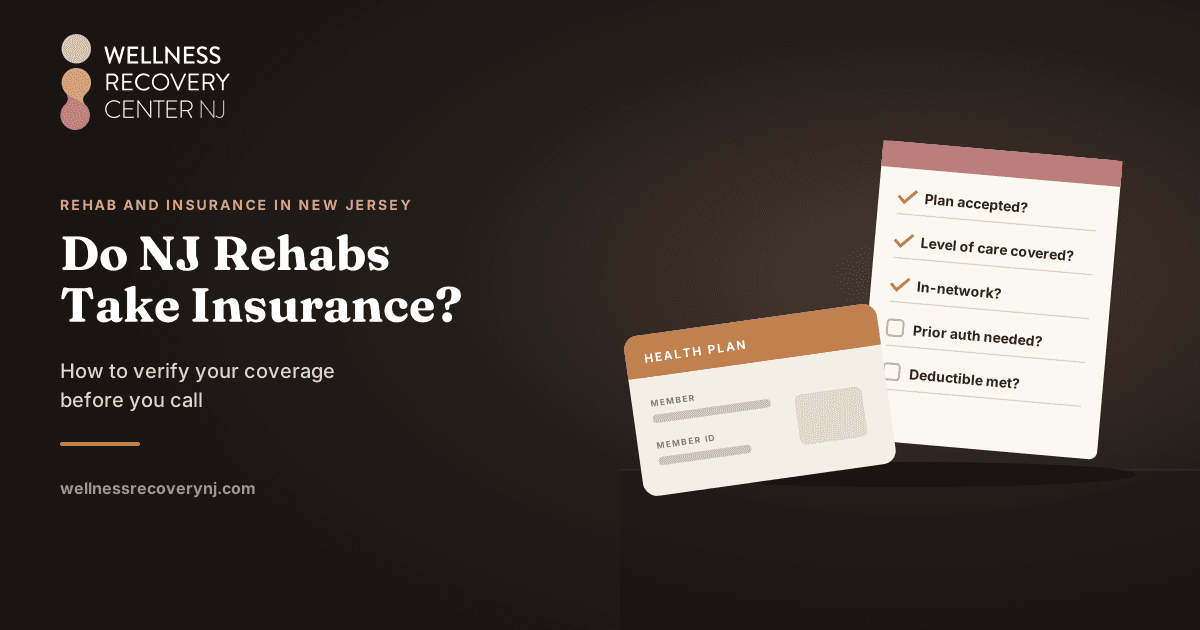
You can verify your benefits yourself by calling the number on your insurance card, before you contact any facility.
Coverage differs by level of care. Detox, residential, partial hospitalization, intensive outpatient, and outpatient are often approved and paid for separately.
In-network care usually costs far less than out-of-network care, and prior authorization can decide whether a stay is paid for at all.
A denial or a short approval is not the end. You can appeal, and you can ask for a peer-to-peer review.
Table of Contents
What addiction treatment insurance typically covers: detox, residential, PHP, IOP, and outpatient
In-network vs. out-of-network rehabs: what it means for your costs
Introduction
You have finally decided to get help, or you have finally convinced someone you love to. Then the next thought arrives: how are we going to pay for this? That worry stops a lot of people before they ever make a call.
There is good news. Many rehabs in New Jersey work with insurance, and your plan may cover more than you expect. This article shows you how to find out exactly what you have, in your own time, before you talk to anyone at a facility. If you would rather have a person walk you through it, Wellness Recovery Center of New Jersey can check your benefits with you.
Do rehabs in New Jersey accept insurance? The short answer
Yes, most do. But "takes insurance" is not one yes or no. A facility may accept some plans from a carrier and not others, or be in-network with one company and out-of-network with another.
So two questions matter. Does this facility accept my specific plan? And does my plan cover the level of care I need? You need a yes to both.
If you have private insurance, buy your own coverage, or are on Medicare or Medicaid, SAMHSA has a page for each situation that explains how to find care and what to ask.[1] New Jersey's Medicaid and CHIP program is listed there as well.

What addiction treatment insurance typically covers: detox, residential, PHP, IOP, and outpatient
Treatment is not one product. It comes in levels, and the American Society of Addiction Medicine (ASAM) publishes the criteria that clinicians use to match a person to the right level.[2] Insurers often use similar criteria when they decide what to approve.
The table below describes each level in plain terms. What your plan pays for each one varies, so treat it as a list of things to ask about, not a promise.
Level of care | What it is | What to ask your insurer |
|---|---|---|
Detox | Medically supervised withdrawal, usually several days | Is it covered as inpatient or outpatient, and how many days are approved? |
Residential | You live at the facility and have a full day of treatment | Is it covered, and does it need prior authorization? |
Most of the day in treatment, home at night | Is PHP covered, and how many days per week? | |
Several sessions a week, around work or family | What is the copay per session? | |
Regular therapy and check-ins, the lightest level | Is there a limit on visits per year? |
Plans do not always pay for these equally. A plan might cover detox well and apply a tight limit to residential days. Ask about each one by name.
If mental health is part of the picture, ask whether dual diagnosis treatment or a mental health IOP is covered under your mental health benefit, your substance use benefit, or both.

How to verify your insurance coverage before you call
You do not need a facility to do this for you. You can do it in about 20 minutes with your insurance card and a pen.
Find the member services number on the back of your card and call it.
Ask for the behavioral health or substance use benefits. Some carriers use a separate department or a separate company for these.
Write down the date, the name of the person you spoke with, and a reference number for the call.
Ask them to send the answers in writing, or check your online member portal, which often lists in-network providers.
If you are not sure where to start looking for programs, the SAMHSA Treatment Locator at FindTreatment.gov and the national helpline at 1-800-662-HELP (4357) can point you to options.[3] For alcohol specifically, the NIAAA Alcohol Treatment Navigator helps you compare the kinds of care that exist and what to look for.[4]
Once you have your own answers, a facility's admissions team can run a formal verification of benefits. That step confirms what you already learned and fills in details only the facility can check.

Questions to ask your insurer about rehab benefits
Phone calls with insurers go better when you have the questions ready. Bring this list.
Does my plan cover substance use disorder treatment? Which levels of care?
Is Wellness Recovery Center of New Jersey (or any facility you are considering) in-network for my exact plan?
What is my deductible, and how much of it have I met this year?
What is my copay or coinsurance for each level of care?
What is my out-of-pocket maximum?
Which services need prior authorization, and who requests it?
Is there a limit on days or visits? How are extensions decided?
Are medications for addiction treatment covered? For opioid use disorder, NIDA describes these medications as safe, effective, and life-saving.[3]
If an answer is vague, ask the same question a second way. "Is it covered?" can get a different answer than "What would I owe for this service code?"

In-network vs. out-of-network rehabs: what it means for your costs
An in-network facility has a contract with your insurer and has agreed to set rates. An out-of-network facility has no such contract, so the insurer pays less, or in some plans nothing, and you may owe the difference.
In-network | Out-of-network | |
|---|---|---|
Your share of the bill | Usually a set copay or coinsurance | Often a higher percentage, plus any amount above what the insurer allows |
Deductible | Usually a lower one | Often a separate, higher one |
Out-of-pocket maximum | Usually lower | Often higher, or none |
Many rehabs in New Jersey are in-network with some carriers and out-of-network with others. That is why the facility name alone is not enough. Always give the insurer your plan and the facility name together.
If the best fit for you is out-of-network, ask whether your plan has out-of-network benefits and whether a single-case agreement is possible. This is rare, but it does happen.

Understanding deductibles, copays, and prior authorization
These terms decide most of what you will actually pay.
Deductible: the amount you pay yourself each plan year before the insurer starts paying its share. If it resets in January, starting treatment in December or January can change your costs.
Copay and coinsurance: a copay is a flat fee per visit. Coinsurance is a percentage of the bill, such as 20 percent.
Prior authorization: approval from the insurer before treatment starts, or soon after. Without it, a claim can be denied even when the service is normally covered.
Authorization is often given a few days or weeks at a time, then reviewed. Approval for a stay is not approval for the whole plan of care. The facility usually sends the clinical information for each review, and you can ask the admissions team how that process works.

What to do if your coverage is limited or denied
A denial feels final, but it is often the start of a conversation. Insurers get decisions overturned on review every day, and you have the right to ask for one.
Ask for the denial in writing, with the exact reason and the deadline to appeal.
Ask your treating clinician to write a letter explaining why this level of care is medically necessary.
Request a peer-to-peer review, where the facility's doctor speaks directly with the insurer's reviewer.
File an internal appeal, and if that fails, ask about an external review by an independent party.
If the insurer approves a shorter stay than your clinicians recommend, a step-down may still protect your progress. Moving from residential to PHP, then IOP, keeps care going at a level your plan will pay for. Our post on what makes a great addiction rehab in New Jersey covers what a good step-down plan looks like.
If you have no insurance at all, the SAMHSA helpline is free and confidential, and it can refer you to programs that offer other ways to pay.[1] Do not let a gap in coverage keep you from asking.
Frequently Asked Questions
Q: Do rehabs in New Jersey take insurance, and which plans are commonly accepted?
A: Most do accept insurance, including many private plans and, at some facilities, Medicaid. Which plans are accepted differs from one facility to the next, so confirm your exact plan name with the facility and your insurer. Wellness Recovery Center of New Jersey can check your benefits with you at no charge.
Q: How can I check if my insurance covers addiction treatment without calling a facility first?
A: Call the member services number on your card and ask for behavioral health or substance use benefits. You can also log in to your insurer's online portal and search the in-network provider list. Write down the date, the representative's name, and a reference number.
Q: What is the difference between in-network and out-of-network rehab, and how does it affect my cost?
A: In-network facilities have a contract with your insurer, so your share is usually lower and more predictable. Out-of-network facilities have no contract, so you may pay a higher percentage plus any amount above what the insurer allows. Always check both the facility and your specific plan.
Q: Does insurance cover detox, residential treatment, and outpatient programs equally?
A: Not always. Plans can set different copays, day limits, and authorization rules for each level of care. Ask about detox, residential, PHP, IOP, and outpatient separately so you are not surprised later.
Q: What can I do if my insurance denies coverage or only approves a short stay?
A: Ask for the denial in writing, then request a peer-to-peer review and file an appeal with a letter of medical necessity from your clinician. If the first appeal fails, ask about external review. A step-down to PHP or IOP can keep treatment going while you appeal.
Conclusion
Insurance does not have to stand between you and care. Many rehabs in New Jersey accept it, and you can learn what your plan covers with one phone call and a list of questions. Check the plan, the level of care, and in-network status, and ask about prior authorization.
If you want help with any of that, Wellness Recovery Center of New Jersey will verify your benefits and explain your options in plain terms. Call us at wellnessrecoverynj.com. If you are not sure what level of care you need, our post on six signs it is time to seek drug rehab in New Jersey is a good place to start.
References
Substance Abuse and Mental Health Services Administration. SAMHSA Home: Find Help and Support, Insurance and Medicaid Resources. - https://www.samhsa.gov
American Society of Addiction Medicine. ASAM Home and The ASAM Criteria. - https://www.asam.org
National Institute on Drug Abuse. NIDA Home: Treatment Resources and Medications for Opioid Use Disorder. - https://nida.nih.gov
National Institute on Alcohol Abuse and Alcoholism. NIAAA Home: Alcohol Treatment Navigator. - https://www.niaaa.nih.gov
Ready to talk to someone?
Confidential, judgment-free, available 24/7.